Demand for Laboratory Information and Management Systems (LIMS) is expected to nearly double over the next five years. The main beneficiaries will be those providers whose LIMS can serve as a data hub, are designed around holistic workflows, and can be integrated with third-party systems—including external ones.
Laboratories are not islands
Market researchers at Markets and Markets predict that the size of the global LIMS market will nearly double over the next five years—from approximately 950 million euros (1.1 billion U.S. dollars) this year (2021) to around 1.8 billion euros (2.1 billion U.S. dollars) in 2026. The analysts cite the crucial role of LIMS in ensuring compliance with strict regulatory requirements, technological innovations in LIMS offerings, and the increasing adoption of cloud-based LIMS solutions as the key drivers of growth.
However, in five years’ time, a LIMS will differ from today’s solutions in many ways. For example, the COVID-19 pandemic has once again underscored the fact that data management is playing an increasingly important role, and that a LIMS must be capable of mapping comprehensive workflows rather than focusing on individual functions.
Furthermore, LIMS systems no longer have a future as standalone solutions. Accordingly, it is not enough for workflows to function within the respective LIMS and a single laboratory; they must also be capable of integrating with third-party systems and the solutions of external business partners. Specifically, this requires largely automated processes and up-to-date, industry-standard interfaces that enable such integration. This is currently one of the biggest challenges facing LIMS providers.
First example: COVID (DEMIS)
Especially since things sometimes need to move quickly. This was recently demonstrated by the “German Electronic Reporting and Information System for Infection Control” (DEMIS). Its goal is to process and transmit health-related information digitally throughout the entire system. This is also intended to reduce the workload for those submitting reports—primarily doctors and laboratories—while ensuring that data reaches the relevant healthcare authorities more quickly—namely, public health departments, state authorities, and the RKI. Although DEMIS has existed as an interface standard for some time, the COVID-19 pandemic acted as a catalyst, accelerating and finalizing many implementations. Background: Last year’s amendment to the German Infection Protection Act, as well as the widely discussed requirement that communication between laboratories, public health departments, and higher-level authorities should no longer take place via fax but rather be digitized and automated through DEMIS.
During this transition, many laboratories discovered just how inflexible their LIMS is when it comes to handling external formats and integrating with third-party systems. This was all the more true given that the issue extended beyond mere data transfer to include further questions: Can the LIMS perform calculations and/or plausibility checks before data is transferred to the DEMIS adapter? Conversely, is it possible to evaluate the adapter’s feedback and make it available to the various LIMS functions? In addition, integration with the Corona-Warn-App was often required.
Among Blomesystem’s customers, for example, state laboratories were particularly affected. Thanks to the modularity of its LIMS LABbase, Blomesystem was able to quickly equip its solution with the required interface and designed it in such a way that it is compatible with any database and any installation.
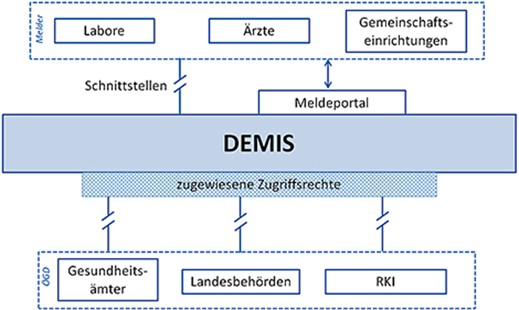
The COVID/DEMIS example underscores that a traditional LIMS, which primarily only connects and interfaces with measuring devices and analyzes their data, is no longer sufficient. Rather, a LIMS today must be capable of functioning as a central data hub for laboratories, integrating various third-party systems both within the lab and with external parties in a centralized manner to create seamless and automated workflows.
Second example: Food safety (AVV DatA)
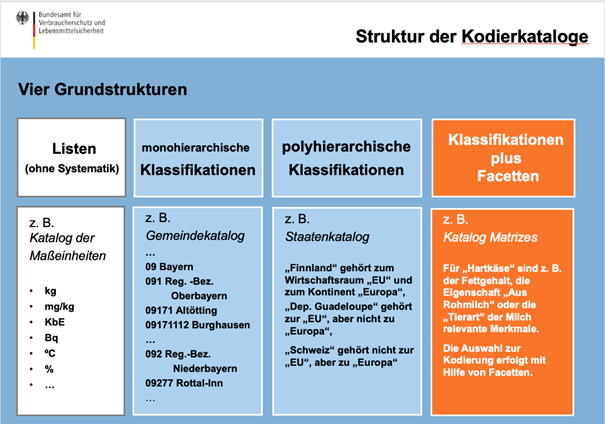
Another example is the AVV DatA interface: The “General Administrative Regulation on the Exchange of Data in the Field of Food Safety and Consumer Protection” primarily governs data exchange between the Federal Office of Consumer Protection and Food Safety (BVL) on the one hand and the state investigative offices on the other. Reports from the state offices to the federal government follow the structure of the AVV DatA catalogs, which must be implemented in their revised form by January 1, 2023, at the latest.
For the laboratories affiliated with the state offices, this represents a significant change: they must now work with lists that have, in some cases, been significantly revised, as well as mono- and polyhierarchical classifications or classifications with facets (see Figure 2). Blomesystem has therefore not only adapted its LIMS LABbase to the new data structures in the user interfaces of its applications. To ensure that data is always checked for consistency and quality, data pre-checks and feedback to the BVL have also been added. Last but not least: During the transition phase from the old to the new system, the respective LIMS must be able to work with both the current and future AVV-DatA catalogs. LABbase bridges this gap.
How Integration Succeeds
Such a transition is only economically viable and feasible within the required timeframe if the LIMS is structured in a vendor-neutral manner—not only so that, in principle, any laboratory instrument can be integrated, but also so that different software from other vendors can be integrated. This results in integrated process control systems that can distinguish between different types of information: Is the information in question a single file, a web service, or simple data that is merely to be forwarded via the network? And how does the data enter the system? What is the definition of the respective data, what should be done with it, and where in the LIMS is it stored? Finally, the output of the data processed by the LIMS: Should this be reviewed again before the test report is generated? And in what format is it output and transferred—possibly even to an external system?
Given these challenges, a LIMS needs to be as flexible and customizable as possible, so the era of standardized interfaces—defined by fixed specifications—is gradually coming to an end. They are being replaced by configurable systems that allow laboratories to set certain functions or data mappings themselves. And if, at a certain point, “real” programming becomes necessary, the developers at the respective manufacturer can make the necessary changes relatively quickly and cost-effectively.
Process over function
The key to such a LIMS is open programming that offers more than just ready-to-use but inflexible functions and integrations. Rather, the solution should follow a modular approach that focuses on overarching workflows rather than individual functions: process-oriented rather than primarily function-oriented. If the LIMS is truly to serve as a data hub, it needs this adaptability. Even if it’s only for data that is merely stored in memory and not processed within the LIMS itself.
The example of COVID once again demonstrates just how important this focus on cross-functional workflows is: In early 2021, as new and more dangerous virus variants emerged, sample sequencing became increasingly important. As a result, many laboratories were no longer required to report only positive or negative results. Instead, the RKI mandated a systematic search for variants and corresponding follow-up reports for numerous samples. This expanded the laboratories’ workflow and required correspondingly enhanced interfaces between laboratories, public health departments, and the RKI.
Without a module- and process-oriented LIMS (see info boxes for key benefits), such rapid adjustments are hardly feasible from an economic standpoint today. This is especially true given that a LIMS must ensure—even when requirements change frequently and at short notice—that, as a central data hub, it facilitates the quick and error-free transfer of measurement data to other systems.
Advantages of a workflow-oriented LIMS
- Users are "guided" through the workflows relevant to them, so that many data entries and steps are self-explanatory
- The necessary functions (and only those) are available at every key stage of the business processes
- The resulting increase in work efficiency leads to significant savings in time and costs
- The costs associated with user training are decreasing significantly
Advantages of a modular LIMS
- Low initial cost: additional modules can be purchased later for expansion
- Focus on actual needs: Customers can purchase only the modules they actually need
- Future-proofing and quick adaptability: Using modules, a LIMS can be quickly adapted to new requirements and expanded with new features.