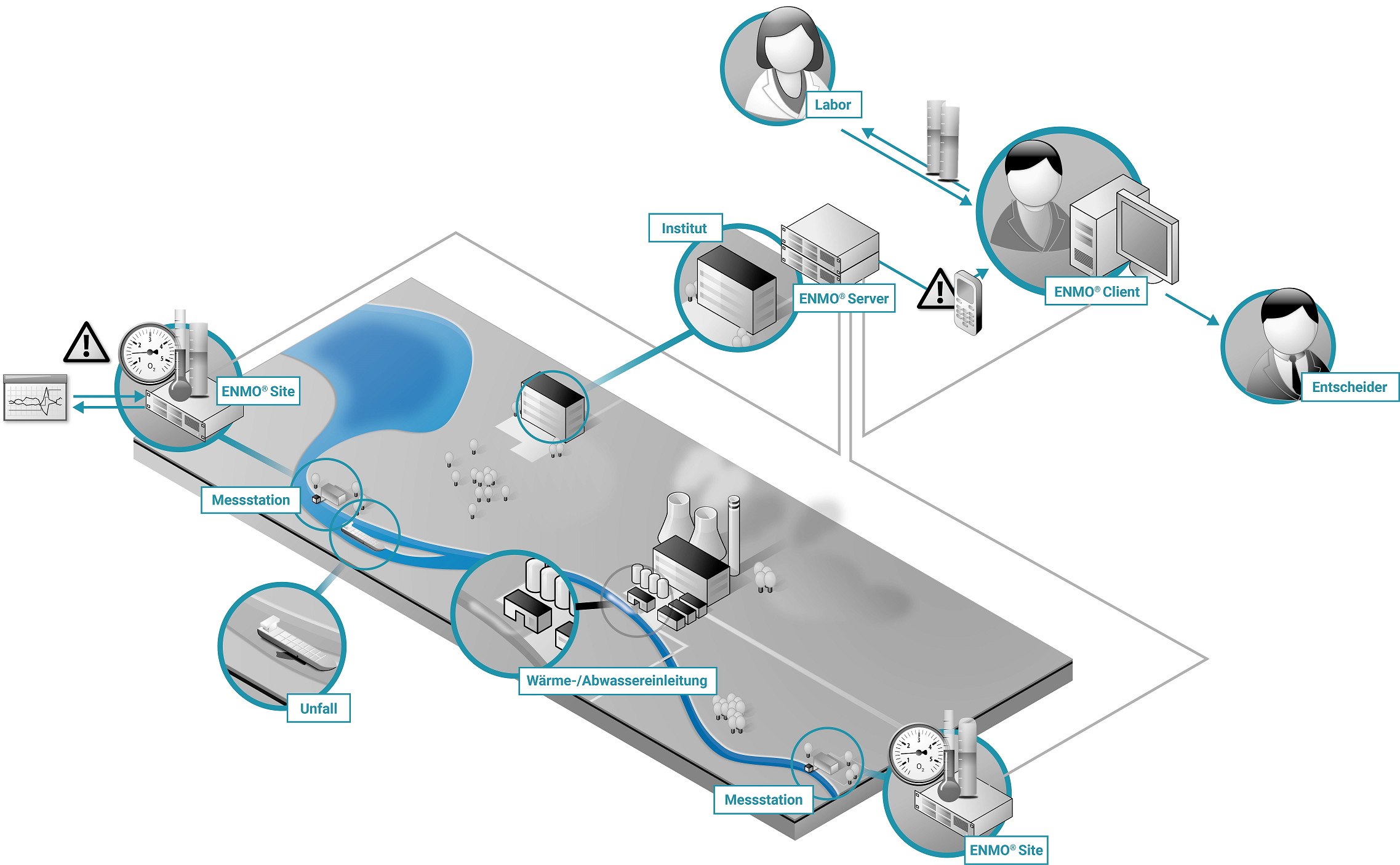
(Image: Schematic representation of an example monitoring network using ENMOhydro. Source: Blomesystem GmbH)
In light of the recent fish kill on the Oder River, the need for ongoing water monitoring—both at the state and European levels—has once again become apparent.
Although not mandatory, the EU Water Framework Directive requires all necessary measures to prevent the release of pollutants into water bodies. The use of early warning systems is becoming increasingly important, as it is not always possible to anticipate and, where necessary, prevent disasters (such as the fish kill mentioned above) through routine water monitoring operations. Monitoring the status of surface waters in accordance with the Water Framework Directive or the Surface Water Ordinance (OGewV) is still carried out in many locations based on monthly or quarterly manual sampling followed by laboratory analysis. A comparison of the annual mean values with the annual average environmental quality standard (JD-UQN) then provides an overview of the status of the water body. However, these values are often insufficient to identify the source of contamination when an exceedance of the UQN is detected. In such cases, laboratory staff usually do not know in advance what they should be looking for. Additionally, some samples must be prepared accordingly before analysis, which takes additional time.
In the case of the fish kill on the Oder River, too, identifying the cause was difficult. The water flows; pollutants are diluted and/or undergo changes, which makes the investigation even more difficult.
In such cases, a higher density of information is required to identify the causes in a timely manner and take the necessary action. This is where ENMOhydro comes in, using emission-based alarm thresholds. Many actions can be automatically planned and/or triggered by the system as soon as a limit value (alarm threshold) is exceeded: e.g., notifying the responsible parties or automatically taking additional samples using automatic samplers.
Continuous monitoring helps identify potential risks early on and respond appropriately.